







 August 29, 2026
I’ve been told that encampment sweeps have gotten better.
That the HOT Team is now in charge instead of RPD. That outreach happens before sweeps. That coordination between outreach workers and the HOT Team makes the process more compassionate.
These are lies.
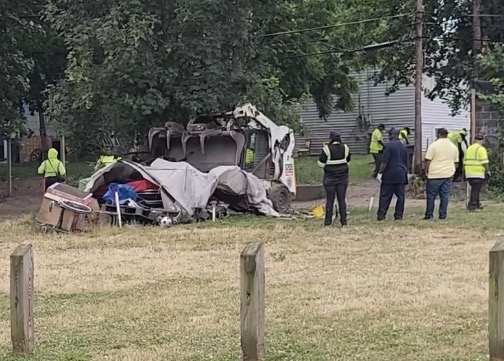
First, the Mayor still refuses to acknowledge that sweeps happen at all. This is despite photos and video evidence of bulldozers destroying people’s only possessions, years of destruction and trauma, and the City’s ongoing attempts to make sweeps appear more compassionate.
The message remains the same: deny, deny, deny.
And while the City denies the reality of sweeps, families living in affected neighborhoods are left dealing with the consequences. Parents should not have to worry about their children encountering unsafe conditions on their way to school. Residents should not feel ignored when they raise legitimate concerns about drug use, public health, or neighborhood safety.
But those concerns cannot be solved by simply removing people experiencing homelessness.
Second, we need to be honest about what the HOT Team actually is. The Homeless Outreach Team is a specialized unit within the Rochester Police Department, operating under the Special Operations Bureau, which is responsible for specialized law enforcement activities.
The City may describe the HOT Team as part of a multidisciplinary outreach model, but putting police at the center of homeless outreach does not magically make that outreach non-police.
There is a fundamental difference between police-led outreach and relationship-based outreach. A police officer approaching someone living outside carries the authority of law enforcement, regardless of whether they arrive with a resource card instead of a citation. That power imbalance matters, particularly for people who have experienced criminalization, harassment, or trauma at the hands of police.
Real outreach takes time. It means building relationships, understanding someone’s circumstances, and working alongside them toward solutions they can actually access.
I have personally experienced harassment from police while conducting outreach. There is an attitude within parts of the City’s response to homelessness that unhoused people are dirty, dangerous, or criminal and need to be dealt with using a heavy hand.
That is not outreach. That is enforcement disguised as outreach.
The supposed coordination between genuine outreach workers and the HOT Team is also hanging by a thread.
There is currently no formal agreement or established procedure between the City and outreach workers to ensure the health and safety of unhoused people during sweeps or guarantee continued outreach after they are displaced. Agreements and procedures have been in development for months, but they are still not finalized.
If “criminal” activity is observed in an encampment, a sweep can happen without warning. That activity might be drug use, or simply a complaint from someone who believes unhoused people should not be there.
Outreach workers can be left off emails or not notified at all. I have personally been asked by employees at the Department of Social Services how I know when a sweep is happening because even they aren’t being told.
So when the City says sweeps are now more coordinated and compassionate, I have to ask: coordinated with whom?
Now, the City has a new talking point: Encampments are dangerous for everyone. That is not the whole truth.
There are encampments where people look out for one another, share resources, and provide community for people who have nowhere else to go. There is safety in numbers. Living outside is dangerous, but that does not mean every encampment is inherently dangerous.
The danger of living outside is exactly why destroying people’s communities without providing somewhere safe to go is so harmful.
When an encampment is swept, the people living there do not disappear. They move to another neighborhood, another vacant lot, another doorway, or another isolated location. Recent research found that displaced residents generally do not move into housing. Instead, they tend to relocate nearby while facing an increased risk of losing contact with service providers.
The families who were asking for help before the sweep are often left with the same underlying problems, only two or three blocks down the street.
This is what happens when displacement is mistaken for public safety.
The City’s focus on encampments allows officials to avoid confronting the real issue: homelessness.
Even improving shelters and making them truly low-barrier would not solve everything. Monroe County itself contributes to unsheltered homelessness through its use of shelter sanctions. People sanctioned from the shelter system can be left with nowhere to go, and most shelters refuse to accept them.
So when the City and County point to shelters as an alternative to encampments, they need to be honest about who can actually access those beds.
And we need to stop pretending that a shelter bed is the same thing as a home.
Shelters are not homes.
We could invest in permanent, affordable housing. We could actually follow the principles of Housing First: getting people into stable housing without requiring them to first prove that they are “housing ready,” sober enough, compliant enough, or deserving enough.
In fact, the City’s own homelessness report identifies Housing First and stronger coordination as priorities. So why is so much of its energy still focused on moving people from one place to another?
The City could also invest in the neighborhoods it is asking families to endure: meaningful responses to public drug use, accessible treatment and harm reduction, public bathrooms, trash collection, mental health services, and community-based outreach.
These are not competing interests.
Families deserve safe neighborhoods. Unhoused people deserve safe apartments to live in. Rochester can and should provide both.
The City can keep changing the language. It can call sweeps outreach. It can call them compassionate. It can call them public safety. But changing the language does not change the outcome.
Stop calling displacement compassion. Stop pretending sweeps solve homelessness. If Rochester wants fewer encampments, then house the people living in them. Stop moving people and start housing them.
Mickey DiPerna is a housing justice advocate and community organizer with Rochester Grants Pass Resistance in Rochester, NY. Their advocacy is informed by lived experience with homelessness and substance-use disorder in their family.










 Prev Post
What do you think?
Show comments / Leave a comment